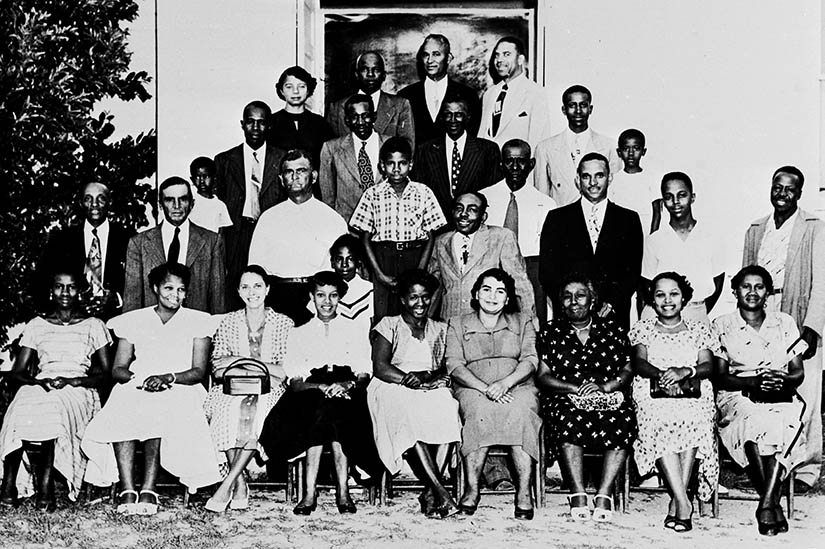
Banner Photo: Petitioners in Briggs v. Elliott (later combined with Brown v. Board), photo courtesy of Cecil Williams
In 1955, Chester Travelstead, Dean of Education at USC, gave a speech [pdf] in which he advocated for compliance with the Supreme Court’s Brown v. Board of Education ruling.
The Museum of Education commemorated this event with a reading of his speech followed by a discussion with panelists Cecil Williams, founder of the South Carolina Civil Rights Museum and Derek Black, professor of law, moderated by Daniella Cook Sumpter, professor of education on on September 30, 2025 at 3 p.m.
Accessibility Note: The linked .pdf file is a scan of an original hand-typed document from 1955, and as such is not readily legible even by modern screen reader standards. A transcript of the speech follows below.
Today's Decisions for Tomorrow's Schools
Lecture delivered at Drayton Hall
Before Summer Session Students
August 2, 1955
Here and now, in the summer of 1955, we find ourselves faced with the necessity of making many momentous decisions with respect to the schools in this country. Perhaps at no other time in the history of education has so greo.t a sense of gravity and urgency characterized the action concerning schools which is being taken and which must be taken in the near future.
Decisions made by men down through history have become milestones in the records of the past. The fact that decisions can become so far-reaching - even to the point of changing the course oi' an entire nation - has made man quite cautious in making decisions. It has made him so cautious in some cases that, at times when decisions and action were so sorely needed, he has neglected altogether to make any decision at all. Cervantes, the 16th century Spanish novelist, expressed this weakness of man by saying, “By the streets of ‘by and by’ one arrives at the house of ‘never’.”
Shakespeare said it somewhat differently. “That we would do, we should do when we would; for this world changes, and hath abatements and delays as many as there are tongues, are hands, are accidents; and then this should is like a spendthrift sigh, that hurts by easing.”
South Carolina’s own John C. Calhoun described a period in the early history of this state in which decisions and action were held in abeyance. Mr. Calhoun wrote, “In the meantime our policy is a masterly, inactivity.”
Students of law, students of administration, students of life itself know that making decisions is difficult - quite often very frustrating. --This calls to mind a story--(story about sorting potatoes into three piles according to size. "These decisions are killing me.”) These same students, however, know full well how necessary it is for clear-cut decisions to be made at strategic points in the development of institutions and social policies. Not only must these decisions be made at appropriate times with clarity and precision; but just as important, they must be fair and just decisions, if mankind is to continue successfully his effort to achieve a more noble level of civilization.
They must also be based on all available relevant information – accurate information. Even small errors can become serious. A decision apparently only slightly in error at the time can become considerably more serious as it is magnified by the passage of time.
For example, consider an incident in Edgar Allen Poe's famous story, "The Gold Bug." You will remember that in the search for the great hidden treasure Jupiter dropped the beetle tied to the end of a string through the right eye of the skull instead of through the left eye of the skull as Legrande had instructed him to do. Of course this was an error of only two or three inches, but when this string reached the ground from the limb of the tulip tree and a line was drawn from the center of the tree through the point thus marked by the string and then extended to a distance of 50 feet from the tree, the error in location became one of several yards. Consequently when they dug for the treasure, they found nothing. It was only after they realized their mistake, returned to the tree, moved the stake over three inches, and drew a line from the tree through the new point that they were successful in finding the treasure. A very insignificant error had made a great difference in this case.
It has often been said that the entire history of this country could well have been changed materially had General Robert E. Lee not insisted upon a frontal attack against the Union forces at Gettysburg or had General Longstreet brought up his reinforcements a few hours earlier at this same battle. Napoleon's defeat at Waterloo night well have been turned to victory had some rather minor decisions been different.
It might be that decisions being made today, which are in error only slightly- as it might seem to us at the present - will turn out to become the major errors of our generation, the turning point of western civilization. If this probability exists in the slightest degree, we cannot afford to treat such decisions lightly. We might cite several major decisions of world-wide political and social significance which are now in the balance: for example, (1) our policy and action with respect to Formosa; (2) our attitude and corresponding decisions concerning Yugoslavia; (3) the part we play in Japan's future; or, (4) our approach to the development of West Germany, or to the unification of Germany. But in this discussion today we shall confine our consideration to decisions which must be made in connection with schools in this United States and in South Carolina - decisions which could be just as important as those dealing with differences between nations.
What are some of the major problems in education about which important decisions must be made today or in the very near future? I shall name several of them and then discuss in detail only two or three. Most of these problems are quite familiar to us, all, but let us summarize them quickly.
- Alarming shortage of teachers
It is estimated that each year in this country we are experiencing a net loss of about 65,000 teachers. That is, we need about 140,000 new teachers each year to replace the dropouts and retired teachers as well as to take care of the increased student population. Whereas, we are graduating from teacher-education institutions each year only about 75,000 teachers. How shall we meet this crisis? Should we raise teachers' salaries? Should we certify persons not completing the regular teacher-training programs? Should we shorten the time necessary to complete this training? Should we offer short-term condensed courses for graduates of liberal arts colleges? Should we offer short refresher courses for persons who have had some teaching experience but who have not taught for many years? Decisions must be made on some of these possibilities. - Critical shortage of classroom space for the increasing school population.
We need at least 100,000 additional classrooms to meet the increasing school population. How much of this job can local communities do? How much of it should and can individual states do? Should we work for and accept federal aid in this respect? Vital decisions must be made by educators and community and state leaders on this crucial problem. - Low level of teachers' salaries.
In spite of significant increases during the past 15 years, teachers’ salaries are still below those of average factory workers. - Teacher certification
The layman is far more aware of the problems of teachers' salaries, and teacher and classroom shortages than he is of the complex problems of certification. But nevertheless, several very challenging questions in this area must be faced and answered: Should we encourage reciprocity of certification among states? If so, upon what basis? Should we rely chiefly upon state certification? Or, should much of this responsibility be carried on a regional basis? Or, in view of some other imminent problems facing us should certification revert to local groups? Shall we endorse the plan recently adopted by the Georgia legislature of revoking the license of any teacher who teaches in a nonsegregated school or who even condones integration? Should classrooms be kept open even though the so-called teacher is poorly trained? Should we overhaul our whole concept of certification so as to allow temporary or permanent certification to many who never have or perhaps never will subject themselves to traditional programs of teacher education? - Teacher Education
What of teacher education itself? Are we sure that we have all the right answers when we say that a teacher must have at least four (and preferably five) years of professional preparation in order to do the job well? Should not we take another look at our basic premises? Can we ignore the fact that many persons who complete such programs successfully never make effective teachers? Can we also be blind to the fact that many successful teachers - have had very little professional training? What does make a good teacher, away? Are we sure we know? In the absence of evidence acceptable to most of us, is it not necessary that we continue to search for answers? Is it not better that we welcome suggestions of new plans - plans which might turn out to be better than those we are now following? Decisions must be made soon on many of these matters. - The nature and extent of the school curriculum.
What shall be taught to what children of what age? What program or curriculum should be followed in public and private schools? Are not many decisions necessary in connection with this question? Are the Arthur Bestor’s, the Rudolph Flesche's, the Albert Lynd's and the Mortimer Smith’s on firm ground when they criticize severely today’s educators for neglect of the fundamentals? If so, what are the educators going to do about it? If these men and others who believe that our schools of today are failing in their obligations are not right, what steps can or should the educators take? Decisions must be forthcoming - decisions based upon fact as well as upon conviction. - Financial support of schools.
Are citizens of South Carolina and of the United States in general aware of the cost of good schools, and are they willing to pay for these schools? Is the public aware that a jet pilot cannot be trained for the same money required to train a state coach driver? Whose business is it to inform the public of such things? Decisions on these questions must be made soon. - I am naming last of all a problem which is perhaps the most crucial one facing us today - that of integration of the races within our public schools.
It goes without saying that the decisions made in connection with this matter will be more spectacular, more far-reaching, and, therefore, more difficult to make than will decisions on other educational matters. Accompanying this question is its corollary, "Shall we have any public schools at all?” If time permitted, I would like to discuss each of these problems, but of course that would be most impractical. Instead, I would like for us to consider at this time only two of these problems - the two, which, in my opinion, are the most urgent in the state of South Carolina today.
- Determining the curriculum of the public schools.
- Integrating the races within our public schools.
1. DETERMINING THE CURRICULUM OF THE SCHOOLS.
With respect to the problem of determining the curriculum, there are many decisions which educators, parents, and the lay public must make - decisions which could well be important milestones in American education. To say that there are differences of opinion in this country concerning what should be taught to what child at what age is putting the matter mildly. Not only do many laymen disagree with educators on this question, but educators disagree among themselves. This is not surprising however, since disagreement is prevalent in all areas of life today. Even intelligent and well-informed national leaders disagree frequently on matters of domestic and international significance. Therefore, it should not be surprising or discouraging, that Dr. Arthur Bestor, the professor of history at the University of Illinois, should disagree with the presen [sic] program he finds in the public schools. It is understandable that a man like Rudolph Flesch should write such a book as “Why Johnny Can't Read”, in which he claims that phonics are being ignored in the teaching of reading. I can even understand why Albert Lynd felt he had to write “Quackery in the Public Schools,” in which the author criticizes sharply practices carried on in teacher education and in teacher certification.
The thinking educator is not disturbed by the publication of such works. Many thinking educators even find that they agree in part with what some of these critics have said. Certainly, no thinking educator discards all such criticism as demagoguery or as evidence of communist infiltration. Nor is the thinking educator “taken in" or thrown off balance by such writings.
In determining the curriculum of our school programs the educator must, it seems to me, be extremely careful not to reject sensible and helpful suggestions from any source. He must make it his business to study these matters - to read or listen to meticulously the opinions of his critics as well as those of his friends and working colleagues. He and the patrons of his school must weigh every possibility in view of the aims and objectives of education in this country, and he is morally and professionally obligated to incorporate the most worthy items - courses and activities - in the school programs. But on the other hand he cannot - he must not be so gullible as to believe all the critics say. He must be keenly aware that critics have a strong tendency to generalize without evidence. He must resist the temptation to give in to the vociferous critic - the critic who ignores facts and research when he makes a sweeping criticism based on insufficient evidence.
For example, in recent years there has been considerable criticism of the more liberal promotion policies practiced in many schools. Perhaps it is true that this practice has been abused in many schools, but it is not without evidence to say that a more liberal promotion policy is a sound practice. Many studies show that keeping a child in the same grade for two or more years is not fruitful. It does not bring about the results we once thought it did, For example, two studies showed that three out of every five children are no better off academically at the end of a repeated grade than they were at the end of the first year they were in the grade. The same studies show that at least one out of every five repeaters makes lower grades on achievement tests at the end of the repeated year than at the end of the first year in that grade. And yet within the last three months the New York City Board of Education has ordered that beginning this fall all children in that system shall be promoted only on a basis of passing an academic examination prepared by persons other than the teacher of the children concerned. The action was taken by the board in response to the accusation that "children are passed whether they know anything or not.” The late Alfred North Whitehead of Harvard University said, "No educational system is possible unless every question directly asked of a pupil at any examination is either framed or modified by the actual teacher of that pupil in that subject.” And yet the New York Board issued its order nevertheless. A teacher from the state of Wyoming reported to me recently that the state of Wyoming even administers tests from the state level to all children in Wyoming, to determine those who are to be promoted. The teacher doesn’t even know which children are promoted until the test results are announced by the State Department of Education.* Certainly this practice is in contradiction to the research findings in this respect.
No profession can afford to be swayed by individual opinion or by popular appear [sic] in general. It must not be blocked in its progress by extreme reactionaries. It cannot revert to practices now outmoded just because "father and grandfather did it that way.” The educator of today can no more ignore the research findings in psychology, in child growth and development, and in the use of instruction materials than the scientist can ignore the discovery and possibilities of nuclear fission, or than the physician can be blind to the miraculous healing power of penicillin. We all make mistakes, and of course we should avoid mistakes, wherever possible; and rectify those made, if we can, but we cannot make progress by reverting to "the good old days,”
Education must face up to this fact, square its shoulders and hold its ground when it is on firm ground. It must be careful, however, to differentiate between firm ground and quicksand, when the critic says, for example, that boys and girls don't read as well nor, as they used to - 20, 30, or 50 years ago - education must cite calmly and yet firmly that most comparative studies show conclusively that the reverse is true. Boys and g girls now do read better than they did a quarter of a century ago. They read and compute much better than they did a half century ago.
Decisions concerning what should be taught to what child at what age and how, should be made courageously, and in light of all available information. this probably means that both the educators and their critics must give some ground. it might mean that educators must admit that we have not been challenging some student to do their best work- that we must provide more adequately for the gifted child, but at the same time Mr. Bestor must yield considerably when he faces the fact that all boys and girls do not have the same potential, that all of them do not have the same interests, that they are not all going to college and therefore it is not only justified but imperative that we differentiate the curriculum, that we make flexible requirements for promotion and graduation.
The answers to these questions cannot be put in the “either or” category. John Dewey says in the opening paragraph of his book Experience And Education “Mankind likes to think in terms of extreme opposites. It is given to formulating its beliefs in terms of ‘either ors,’ Between which it recognizes no intermediate possibilities. When forced to recognize that the extremes cannot be acted upon, it is still inclined to hold that they are all right in theory, But when it comes to practical matters, circumstances compel us to compromise. Educational philosophy is no exception.”
Following this premise, educators might be willing to reveal that in many schools teachers have neglected the use of phonics and the ways in which it will be helpful to children. But at the same time Mr. Rudolph Flesch will be forced to retract his statement that phonics are not taught in American schools today. He must admit that phonics is only one method of word attack. It is not the panacea to all our reading difficulties. He might have to retract his statement that there are no remedial reading problems in Austria or Germany, or must be revealed his that the screening and selecting process carried on among school children in those countries eliminates from consideration many of those of lower abilities and. Academic achievement.
Decisions made by educators and laymen concerning the curriculum content of our schools will be based on a broad understanding of these things. The challenge for us all as far reaching.
2. Integration of the races in the public schools.
The problem of integrating the races in our public schools is unprecedented for those of us who were born and raised in the southern states. It is a crucial problem in South Carolina today. Educators and laymen in this state are faced with the necessity of making important decisions related to this matter. The time has passed, it seems to me, for us to hide our heads in the sand and ignore the existence of the problem.
I must say in the beginning that I have been surprised and disappointed that the education profession in South Carolina has made no public statement giving its views on the matter. I have seen nothing in print, nor have I heard any official pronouncements from any of the official education organizations, including the State Board of Education, confirmed concerning their positions on this question. Neither have I any way of knowing the reactions of these organizations to the recommendations of the Grissette Committee and the resulting action taken by the 1955 South Carolina Legislature concerning segregation in the schools. I must add that I do not consider the Grissette Committee representative of the education profession in South Carolina. It is a legislative committee appointed to advise the governor and the legislator on a particular problem in education.
In the absence of such statements from the professional organizations, we cannot know how the members of these organizations feel about this problem period perhaps one would say that silence indicates occurrence with action being taken but of course this may or may not be true. Silence can in some cases indicate opposition, coupled with a great reluctance to speak one views- reluctance because of fear of embarrassment, ridicule or reprisal. Be that as it may, it seems imperative to me that this or any other issue of so great import deserves and demands public discussion.
It is my firm conviction that enforced segregation of the races in our public schools can no longer be justified on any basis, and should therefore be abolished as soon as possible. Even though as a white southerner, I have since my early childhood taken for granted the practice of segregation, I can find no justification for it. As I study the Judeo-Christian concept prevalent in western civilization; As I examine the basis of our own government- the Bill of Rights in all their pronouncements of our forefathers- I find nothing which requires, justifies, or even allows a notion of second class citizenship for any group. I find no conclusive evidence that any one group of men is for ordained to be superior or inferior to other groups of men. I even find this notion of race and national superiority came to a ruinous ended Nazi Germany. For races or nations of men to think and act upon the assumption that there is the superior race or nation and that all other groups are inferior is to invite disaster and downfall. None of the great religions dictate such a creed. Instead all of them say, in essence, but each man and woman is judged according to his own beliefs and acts. The fact that we have practiced segregation on the assumption that it was right and just, does not make it right and just. Dr. John Hardin Marion, Pastor of Bon Air Presbyterian Church in Richmond Virginia, said here recently in his baccalaureate sermon to the University of South Carolina faculty and senior class, that having done a thing- even over a long period of time- does not mean necessarily that it is right. He said we need constantly to analyze our beliefs and practices to see if they are consistent and if they are supported by all available information related to these beliefs and practices period to make such analysis of our actions as difficult- even quite frustrating- but still it is probably necessary if we are to move forward and upward rather than to retrogress.
Besides one's own personal beliefs in this matter, there is a legal side of the question of segregation. All peace loving and law-abiding citizens believe that the laws of the state and of the nation should be respected and obeyed, in spite of the fact that every law seems unjust or unnecessary to some people. In the present case the highest court of our land has said that the practice of segregation of races in the schools is unconstitutional. This court is referring to the Constitution of the United States which most of us have at one time or another sworn to defend. Allegiance to this constitution does not allow us the luxury of upholding it if and when we think that it suits our purposes and tastes; Rather does it require of us that we uphold it and obey it as it exists, having been amended and interpreted through the years by our duly chosen bodies.
If we choose to maneuver and manipulate in order to circumvent these duly constituted agencies of law, how will we explain and justify this action to our children and to our children's children? Can we on Monday tell them to obey the law and have respect for the agencies of law and order, and then on Tuesday tell them they don't need to obey the law, that it is right to circumvent the law as long as they don't get caught? Our recent action in South Carolina and in several other southern states seemed to be an attempt to circumvent the law but so to do it that we “won't get caught.”
Education takes place in many ways. Our children can be educated to deceit and chicanery, as well as they can be educated to integrity and loyalty. This education of course is not confined to their schools or homes. These children learn from everything they see in here. And this crucial matter which faces us all in 1955 our children will learn much by observation of our words and deeds. We certainly have an obligation to them in this respect.
There comes to mind of course, the question of what to do when parts of the state constitution are not in agreement with parts of the federal constitution. If one looks at this situation as a citizen of the United states, he can give only don't answer period he must support the federal constitution. The three judge court here in Colombia on the 15th of last month bore this out. These three judges of unquestioned integrity simply told the Summerton school district to make the necessary arrangements and then proceed forthwith toward desegregation. Respective of their personal opinion about this matter, these judges knew that the supreme law of the land must be upheld.
Recently when the attorney general of Kentucky was asked his opinion about the conflict of the Day Law of Kentucky requiring segregation of races in the public and private schools of that state, and the recent rulings of the Supreme Court of the United states comma he declared simply that the Kentucky law is now null and void. Governor Weatherby of Kentucky followed by saying “We will do whatever is necessary to comply with the supreme court ruling.”
That statements have not yet been made by state officials in South Carolina, but the fact remains that all South Carolina laws requiring segregation by race in the public schools are now null and void. In this connection I would like to quote a recent editorial in the Florence, South Carolina, Morning News.
“Any changes we make in our program of education should be made in full acceptance of the fact that the South cannot maintain its policies of racial segregation for any length of time into the future.
Since the course publication of its implementation decree, the Southland has been feeding itself large doses of self-delusion and false hope. Politicians writers wistful-thinkers and the unthinking have been telling our people that the courts decree can be defeated and will be defeated.
The Court’s decree will not be defeated.
South Carolina’s people need to hear realism. They need to hear the truth. They need to prepare themselves for a realistic future constructed out of words and blind hopes of those who have not accepted the inevitable.”
A federal judge in Texas this last week ruled officially that the Texas laws requiring segregation of the races in the schools are now null and void. It is reasonable to assume that judges in other states will make similar rulings very soon. In some sections of the South boards of education have gone on record as agreeing with the Supreme Court decisions and is being willing to work towards an early implementation of the decision. I cite only three of these:
- In the summer of 1954 the Greensboro, North Carolina Board of Education said in effect that it expected to work towards this gradual integration of the races in the schools of Greensboro. This statement followed the first Supreme Court ruling by a few weeks.
- In June, 1955 the Board of Education at Newport News VA said in substance that it was in agreement with the ruling of the Supreme Court and it wanted to work towards carrying out that ruling on some reasonable basis.
- In July, 1955 the Board of Education at San Antonio, Texas announced that it plans to begin desegregation in public schools this fall. Superintendent Thomas Portwood said in an end to segregation would be achieved by a gradual mixing of Negro and white children. He acted after the board directed him to proceed with “good faith compliance” with the Supreme Court ruling.
Now another aspect of this question of segregation is that of its implications for international relations. Even if all white people were personally in favor of segregation, even if the practice of segregation had not been declared illegal; one should still be keenly aware of the significance of this problem as the United States is trying so valiantly to gain the support of such countries as india, Egypt, and many other nations in asia africa europe and South America. In our grave struggle against communism as a world power, we gain or lose prestige according to our practices back home, rather than our by our words said abroad. World travelers, both natives of the United States and of other countries, tell us seriously and emphatically that our continued practice segregation of the races in this country is jeopardizing our position in world affairs. This possibility is worthy of our serious consideration.
Alternatives
What are the alternatives? What are choices we have in this matter? As we boil down the various possibilities with respect to this question we have left 4 main alternatives. These might be stated very simply:
- accept the Supreme Court decision wholeheartedly and work sincerely towards its implementation.
- Reject completely the court decision and work persistently to keep our public schools segregated by attempting to circumvent,
delay, and out-maneuver the law. This alternative might be accompanied by threatened
economic boycott against anyone opposing racial segregation- a practice recently suggested
by the Mississippi White Citizens Council. This council also has the avowed purpose
of discouraging Negro voting.
(These two alternative are not likely to get large followings) - Agree upon and submit for the approval of the appropriate court a plan of “good faith compliance” With the Supreme Court ruling. If followed, this step would probably be taken in each local community and school district in the state after due consideration by the local citizens. It would be a plan of gradual desegregation and integration, arrived at reluctantly but sincerely.
- Abolish our public schools and attempt to set up private schools on a segregated basis.
The decision to take anyone of these four courses will be a major one period the last two alternatives will probably get many followers in the initial stages of the decision making. Whatever plan is chosen will determine future direction of action in this matter. Therefore, such as decision by educators, community and state leaders should be made only after careful consideration of the possible consequences of each choice the third alternative that of submitting some plan of “good faith compliance” is possible only if certain state laws are changed. I do not refer to the law requiring the segregation of the races in the schools, because that law is, in effect, already null and void. But I do refer to laws recently passed, such as the one cutting off all state money from any school district which assigns Negro and white children to the same school. Obviously a local school district cannot operate at this time without financial aid from the state. Such laws as this, passed by the 1955 legislature, constitute real obstacles to local school districts wishing to comply with the Supreme Court ruling period of course these laws were passed for this purpose, but they can be repealed if, after due consideration, most school districts decide they want to submit some plan of “good faith compliance” rather than abolish their public schools.
The possible consequences which might follow the fourth alternative- that of abolishing the public schools- are many. First, we must as ourselves if we are willing to turn back the cloc on education more than a hundred years. Are the educators, parents, and the lay public willing to consider mass organization of private, parochial an pauper schools, according to the prevalent custom in several of the Atlantic seaboard states in the 1820s and 1830s? Can we be at all sure that were we to decide to abolish the public schools and set up state-financed private schools on a segregated basis that the courts would not strike down this plan as unconstitutional? Are we at all sure that in 1960 and 1970 education with its increasing problems and student enrollment can be handled effectively through such a plan- if it were to be held legal? What about organization, standards, supervision in such a case? Who would educate the teachers and on what basis? Who would handle certification and on what basis?
These are but a few of the back-breaking questions that face us in case we decide to abolish public schools. Because of these and other reasons, most people do not want to abandon public schools, if it can possibly be avoided.
Wise men will go slow in this matter. Thinking men are not at all certain that abolishing the public schools will correct our troubles.
STORY
Uncle was wont to give out bits of hard-headed advice to his young nephew.
“Yes Tommy,” he said one day, “fools are certain; wise men hesitate.”
“Are you sure, Uncle John?” asked Tommy.
“Yes, my boy, I’m certain of it!”
Chales F. Carroll, State Superintendent of Public Instruction In North Carolina, was quoted last week in an Associated Press story as saying that “Abandoning the public school system is not the answer to the question of racial segregation.”
Carol continued by adding, “One million children in whose hearts, minds and hands rest much of the destiny of this state are innocent parties to the segregation matter, and they must not become its victims. Every American state views public education not as an option, but as an imperative.”**
The legality of abolishing the public schools would not be questioned if the state and local school authorities made no attempt whatsoever to use public tax money for financing private education in any way. Certainly a private citizen or group of private citizens could carry on a private school on a segregated basis. But just as soon as the state attempts to sell or give the buildings to these private citizens to be used for segregated schools- just as toon as the state or local school districts make available to individual parents or children money which is to be used for education on a private basis- the legality of such action will be challenged and tested in the courts. Since such a case has not yet appeared, one can only guess the outcome.
If public schools were abandoned, what would happen to teacher certification, supervision from the state level, and state-supported teacher education institutions? Nobody can predict with assurance the answers to many of these questions. In looking ahead, one can only be sure that we can expect many problems- difficult problems- to appear if we abolish the public schools.
Decisions concerning these maters must be made- and must be made soon. They will be determined by several factors, all of which will play important parts:
- What we may do under federal law and what we are directed to do by federal authorities.
- What we may and may not do under the state constitution and South Carolina statutes.
- How out state leaders (governmental and educational) feel about what should be don and in what ways they encourage people to go.
- How we as individual parents, teachers, adult citizens and boys and girls feel about the direction we should go. How we feel could lead to the organization of “White Citizens Action Committees” such as the one organized recently in Harleyville, South Carolina. The chief purpose of this organization is “not to accept the Supreme Court’s recent interpretation of our United States Constitution and to work actively to maintain a school on our present segregated basis- even to maintain a private school for our children.”***
Or, how we feel could lead us to hold conferences and discussion groups such as the three-weeks seminar held last month on the University of Kentucky campus. The purpose of this seminar was to study problems of desegregation in the schools of Kentucky.
Yes, how we feel today or how we discipline ourselves to feel tomorrow and next year will be one of the most potent factors of all. Because laws themselves are subject to how the public and its representatives feel about matters. Thus, laws can be made and laws can be repealed, according to how we as individuals and groups feel about a thing.
In this connection, I would like to close with two quotations- one from Epictetus, the early Roman philosopher, and one from John Ruskin.
Epictetus said: “In a word, neither death, nor exile, nor pain, nor anything of this kind is the real cause of our doing or not doing any action, but our inward opinions and principles.”
Ruskin said, and with this I close:
“Doing is the great thing. For if, resolutely people do what is right, in time they come to like doing it.”
*True in 1952 according to a graduate student who teaches in Wyoming.
**Reported in July 29 or July 30 edition of The State.
*** July 21 or 22 of The State.