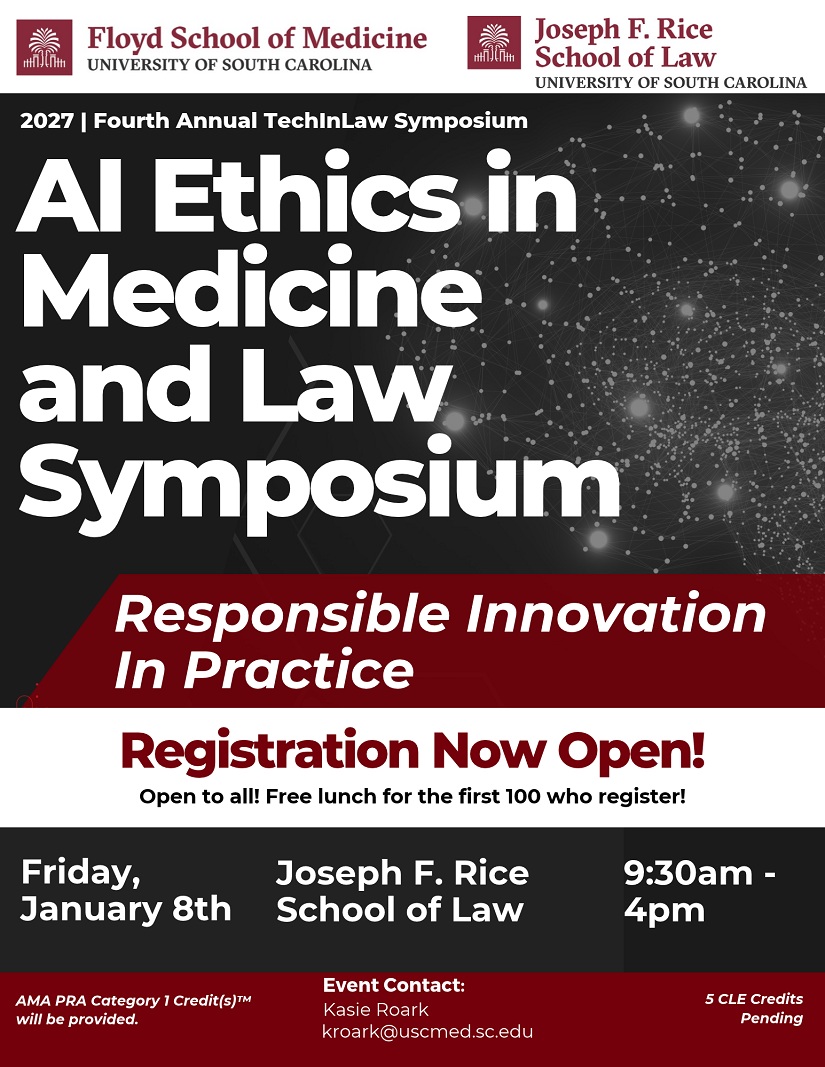
Fourth Annual TechInLaw Symposium
AI Ethics in Medicine and Law Symposium - Responsible Innovation in Practice
Friday, January 8, 2027
Karen J. Williams Courtroom
USC Joseph F. Rice School of Law
Online via Zoom Webinar
Register Here
Symposium Archive
Agenda
- Stickers on badge denoting AI interests for conversation icebreakers
- Green – AI Regulation and Policy
- Yellow – AI in Professional Practice
- Pink – AI in Education and Research
- Orange – AI in Society
- Purpose: Welcome attendees and introduce the symposium's theme and objectives.
- Goals:
- Establish the importance of interdisciplinary collaboration in responsible innovation.
- Provide an overview of the day's sessions and learning objectives.
- Speaker: Gary Moore
Focus: A concise, interdisciplinary review of significant developments in AI capabilities,
adoption, and professional practice since the previous TechInLaw Symposium, highlighting
how these changes are shaping medicine, law, and higher education.
Potential Topics:
- Major advances in AI capabilities and their expanding applications across professional settings.
- Emerging uses of AI in clinical care, legal practice, education, and research.
- Changes in professional workflows, decision-making, and reliance on AI-assisted technologies.
- Significant developments in AI-related law, regulation, privacy, and information governance.
- Evolving institutional policies, professional standards, and approaches to responsible AI adoption.
- Emerging opportunities and challenges associated with integrating AI into established professional and institutional environments.
Goals:
- Establish a shared understanding of significant AI developments since the previous symposium.
- Highlight how AI adoption is transforming medicine, law, and higher education.
- Identify emerging professional, legal, and institutional considerations associated with these developments
- Provide a foundation for the symposium's subsequent discussions of responsible innovation, human vulnerability, professional judgment, and technological risk.
Style: Lightning talks or fireside chat style
Speakers: Jack Pringle, Rebecca Smith, and Mark Uline
Moderator: TBD
Focus:
- Explore how emerging technologies, particularly AI in healthcare, can be thoughtfully developed and implemented to address real-world needs and benefit diverse individuals and communities, with consideration for accessibility, end-user perspectives, and minimizing unintended consequences.
Potential Topics:
- Emerging applications of AI and biomedical informatics in healthcare and research.
- Opportunities for technological innovation to improve healthcare delivery, accessibility, and patient outcomes.
- Human-centered approaches to technology development and implementation.
- The importance of considering diverse patient needs and end-user perspectives throughout the innovation process.
- Considerations for maximizing the benefits of emerging technologies while minimizing unintended consequences, particularly for vulnerable or underserved populations.
Goals:
- Highlight how advances in AI and biomedical informatics can address real-world healthcare needs.
- Explore how thoughtful technology development and implementation can support accessibility and benefit diverse populations.
- Emphasize the importance of incorporating end-user perspectives and anticipating potential unintended consequences in responsible innovation.
Style: Lecture with Q&A
Speaker: Jihad Obeid
Activities:
- Opportunity to visit Vendors
- Networking Icebreaker:
- Stickers on badge denoting AI interests for conversation icebreakers
- Green – AI Regulation and Policy
- Yellow – AI in Professional Practice
- Pink – AI in Education and Research
- Orange – AI in Society
Food:
- Boxed Lunch provided for first 100 registrants from Horseshoe Catering
- Handed out at designated table
- Food Trucks -Located outside for other attendees
- Tacos Oink Oink
Focus:
- Examine the opportunities, challenges, and ethical considerations associated with using emerging technologies in sensitive or high-stakes settings, particularly when individual vulnerability, autonomy, trust, and professional judgment are central to decision-making.
Potential Topics:
- Emerging applications of AI in clinical decision-making, mental healthcare, and other sensitive professional settings.
- Opportunities and challenges associated with using AI to support individuals with diverse clinical, cognitive, and behavioral needs.
- The implications of emerging technologies for patient autonomy, informed consent, trust, and individualized care.
- Potential risks involving privacy, discrimination, and unequal impacts across different populations.
- The capabilities and limitations of AI systems in high-stakes applications, including considerations surrounding reliability and appropriate human oversight.
- The ethical, clinical, and legal responsibilities associated with using emerging technologies when decisions may significantly affect individuals and communities.
Goals:
- Explore how emerging technologies can support care and decision-making in sensitive or high-stakes settings.
- Examine the ethical and practical considerations associated with using these technologies among individuals with diverse needs and circumstances.
- Highlight the importance of patient autonomy, trust, professional judgment, and appropriate oversight.
- Integrate medical, legal, and technical perspectives to better understand the opportunities and challenges of responsible technology use.
Style: Interdisciplinary panel with with audience Q&A.
Speakers: Laura Lane Steele, Kevin Bennett, Paul Toriello, Homayoun Valafar, and Sien Susumu Rafael River
Moderator: Tony D’Elia
Focus:
- Explore the evolving relationship between technology and human judgment, expertise, and professional responsibility, considering what should remain fundamentally human as AI becomes increasingly capable and integrated into professional practice.
Potential Topics:
- The evolving role of human judgment and professional expertise in an AI-driven world.
- The importance of empathy, trust, and human relationships in professional practice.
- Opportunities and challenges associated with human-AI collaboration.
- How emerging technologies are changing the meaning and expectations of professional expertise.
- The ethical responsibilities of professionals when relying on AI-assisted technologies.
- Preserving human agency, dignity, and accountability while embracing technological innovation.
Goals:
- Examine the enduring importance of human judgment, relationships, and professional responsibility as AI capabilities advance.
- Explore how emerging technologies may complement or transform traditional professional roles and expertise.
- Encourage reflection on the distinction between what technology can accomplish and what responsibilities should remain with humans.
Style: Lecture with audience Q&A
Speaker: James Sandman
Coffee and Snacks
Central Question: As technological capabilities advance faster than our ability to fully understand their consequences, when should society allow innovation to proceed, and when do potential harms justify intervention?
Focus: Explore the balance between advancing beneficial technologies and addressing potential risks, considering how medicine, law, and society can encourage responsible innovation while protecting individuals and communities.
Potential Topics:
- Balancing the potential benefits of technological innovation against emerging or uncertain risks.
- The consequences of intervening too early or too late in technological development and adoption.
- Determining appropriate levels of risk and responsibility in high-stakes professional settings.
- The roles of regulation, professional standards, and institutional oversight in responsible innovation.
- Differences and similarities in how medicine and law approach technological risk, safety, and accountability.
Goals:
- Encourage thoughtful consideration of the opportunities and risks associated with emerging technologies.
- Explore differing perspectives on when and how intervention may be warranted.
- Examine the responsibilities of professionals, institutions, and policymakers in balancing innovation with appropriate safeguards.
Style: Modified Oxford Debate
Format:
- Opening statements (5 minutes each)
- Cross-examination (speakers question each other)
- Audience Q&A
Speakers: Tony D’Elia, Jeff Gerac, Bryant Walker Smith, and Brian Keisle
Moderator: Tanner Dean, J.D. Candidate, Class of 2028, University of South Carolina Joseph F. Rice School of Law
- Purpose: Conclude the symposium and encourage continued engagement
- Goals:
- Reflect on key takeaways and opportunities for future collaboration.
- Thank participants and invite feedback for future symposiums.
- Provide instructions for claiming CME/CLE credits and staying connected.
- Speaker: Leonardo Bonilha
This activity has been planned and implemented in accordance with the accreditation requirements and policies of the Accreditation Council for Continuing Medical Education (ACCME) through the joint providership of The University of South Carolina School of Medicine – Prisma Health–Midlands Continuing Medical Education (USCSOM-PHM CME) Organization and the Joseph F. Rice School of Law. The University of South Carolina School of Medicine – Prisma Health–Midlands Continuing Medical Education Organization is accredited by the ACCME to provide continuing medical education for physicians.
Relevant financial relationships and acknowledgements of commercial support will be disclosed to participants at the conference. Faculty are required to disclose off-label/investigative uses of commercial products/devices.
AMA PRA Category 1 Credit(s)TM will be provided. The exact amount will be determined once the agenda is finalized.
Bios
Kevin J. Bennett is a Professor of Family & Preventive Medicine at the University of South Carolina Floyd School of Medicine in Columbia, SC. He serves as the Director of the South Carolina Center for Rural and Primary Healthcare (CPRH) and as the Rural Fellow within the Commonwealth Fund. He served as the president of the National Rural Health Association in 2024. His work focuses on improving healthcare delivery for marginalized and underserved communities, particularly in rural areas, while examining the influence of national, state, or local policies and legislation on these populations. He has worked extensively with community groups, rural health networks, healthcare systems, and state agencies to pioneer and assess innovative care delivery programs. He also has an extensive publication history examining the disparities in healthcare access, quality, and outcomes experienced by rural populations.
Leonardo Bonilha is a physician-scientist and professor of neurology with over two decades of clinical and research experience. He currently serves as Clinical Director for USC Brain Health and Associate Vice President for Health Sciences at USC. He also co-leads the AI in Medicine Extracurricular Track at the Floyd School of Medicine. Board certified in Neurology, Epilepsy, and Clinical Neurophysiology, Dr. Bonilha’s research centers on brain network adaptations to injury, with a focus on language recovery after stroke and neural mechanisms in epilepsy. He has authored more than 290 peer reviewed publications and has led multiple clinical trials advancing the understanding of brain function and rehabilitation.
Anthony D’Elia is the Chief Privacy Officer for the State of South Carolina and an Adjunct Professor at the USC Joseph F. Rice School of Law, where he serves on the Advisory Board for the TechInLaw Initiative. His work focuses on the intersection of technology, privacy, and law, advising on data privacy, incident response, and IT policy. He previously served as Data Privacy and Cyber Counsel at BlueCross BlueShield of South Carolina and as Chief Information Security Officer and Assistant General Counsel for the South Carolina Department of Natural Resources. A former clerk for Chief Judge James E. Lockemy of the S.C. Court of Appeals and a combat veteran of Afghanistan, D’Elia is also a frequent speaker on ethical and professional issues in technology and artificial intelligence.
Jeffrey Gerac is the Chief Medical Informatics Officer for Acute Care at Prisma Health and a Clinical Assistant Professor at the University of South Carolina School of Medicine Greenville and Clemson University. Board-certified in clinical informatics, internal medicine, pediatrics, and pediatric hospital medicine, he specializes in the safe and effective integration of healthcare technology into clinical practice. His work focuses on electronic health record optimization, human factors engineering, patient safety, and clinician well-being. Dr. Gerac has led system-wide clinical technology initiatives, including the implementation of tools to improve sepsis care, and collaborates with researchers to advance clinical workflows and human-technology interactions.
Brian Keisler is the Assistant Dean for Clinical Curriculum and Assessment and a Clinical Associate Professor of Family and Preventive Medicine at the University of South Carolina Floyd School of Medicine, where he also serves as Interim Associate Dean for Undergraduate Medical Education. Board-certified in family medicine and sports medicine, Dr. Keisler has been a faculty member since 2005 and has extensive experience in clinical practice, medical education, and academic leadership. He has received multiple teaching awards and serves on committees within the university and Prisma Health. His professional interests include medical student education, primary care, and sports medicine.
Laura Lane-Steele, JD joined the University of South Carolina School of Law in 2022. Her research focuses on questions of sex discrimination across different areas of law, including constitutional law, anti-discrimination law, and family law. Prior to joining South Carolina Law, Lane-Steele was a Forrester Fellow at Tulane Law School. She also clerked for the Honorable Jane R. Roth of the United States Court of Appeals for the Third Circuit and practiced law at Steptoe & Johnson LLP. She earned her Juris Doctorate from Harvard Law School in 2016 and her Bachelor of Arts degree from Washington University in St. Louis in 2010. Prior to law school, she taught middle and high school math and science in Washington, D.C.
Gary Moore has served as the Assistant Dean for Academic Technology at the USC Joseph F. Rice School of Law since 2012, where he leads the school’s technology strategy to enhance teaching, learning, and scholarship. He is also the Executive Director of the Technology, Innovation and Law Collaborative, aka TechInLaw, overseeing its symposia and the LegalTech CLE Seminar Series. Moore is a former Chair, formerly Co-Chair and currently a member of the University's unITE working group. He was also the former co-chair of the University’s Information Technology Community (ITC), fostering collaboration and shared governance across IT teams. Gary plays a key role in advancing interdisciplinary innovation in legal education. He holds a B.S. in Computer Science from Hofstra University and is a member of IEEE and IAPP.
Jihad Obeid, MD, FACMI, FAMIA, is a Professor and SmartState Endowed Chair in Biomedical Informatics at the Medical University of South Carolina (MUSC), where he serves as Assistant Vice President for Research on AI Strategy and Research Intelligence. A pediatrician by training, he completed a medical informatics fellowship through the joint Harvard-MIT Division of Health Sciences and Technology. Dr. Obeid co-founded MUSC's AI Hub and directs the Cancer Integrated Data Enabled Resource (CIDER). His research focuses on artificial intelligence, deep learning, large language models, and natural language processing, particularly their applications to electronic health record data, clinical text mining, and predictive modeling. He has led numerous research informatics initiatives and contributed to federally funded projects advancing biomedical informatics and healthcare innovation.
Jack Pringle is an attorney with Nelson Mullins in Columbia, and helps organizations manage information.
Jim Sandman is Distinguished Professor of Practice and Public Service at the University of South Carolina Joseph F. Rice School of Law. He is also President Emeritus of the Legal Services Corporation, the United States’ largest funder of civil legal aid programs, and Chair of the District of Columbia Access to Justice Commission. He practiced for 30 years with Arnold & Porter and served as the firm’s Managing Partner for a decade. Jim is a member of the American Law Institute and the American Academy of Arts and Sciences. He is a recipient of American Lawyer’s Lifetime Achievement Award
Rebecca Starr Smith is a board-certified family medicine physician at Prisma Health's Keystone Family Medicine and a Clinical Assistant Professor at the University of South Carolina School of Medicine Greenville. She serves as the Ambulatory Electronic Medical Record Optimization and Patient Engagement Lead at Prisma Health, where she focuses on improving clinical workflows, healthcare technology integration, and patient engagement. Dr. Smith is a Certified Physician Executive and holds certification in Artificial Intelligence in Healthcare from the American Board of Artificial Intelligence in Medicine. She has held numerous leadership roles in clinical informatics, digital health, and primary care, including serving as Co-Chair of the Epic Primary Care Advisory Group. An experienced educator and speaker, she has presented extensively on AI in healthcare, electronic health record optimization, and the evolving role of technology in clinical practice.
Sien Rivera is Assistant Program Director of the Prisma Health Midlands/University of South Carolina General Psychiatry residency program, and Assistant Clinical Professor at the University of South Carolina School of Medicine. They are a psychoanalytic psychotherapist that is double boarded in General and Child/Adolescent Psychiatry. They are a former fellow of the American Psychoanalytic Association, former chair of the American Psychoanalytic Association's Committee on Gender and Sexuality, and a winner of the Ralph Roughton Paper Award. They currently serve as a member of the Group for the Advancement of Psychiatry’s LGBTQIA Committee. They write and present nationally and internationally on topics related to gender, sexuality, and new technologies.
Paul Toriello is a Clinical Professor of Neuropsychiatry and Behavioral Science and Assistant Dean for Clinical Graduate Programs at the University of South Carolina’s Floyd School of Medicine. Since completing his doctorate in rehabilitation from Southern Illinois University (Carbondale) in 1998, he has served as a clinical counselor educator, researcher, practitioner, and in various academic and clinical leadership positions. Dr. Toriello’s interest is innovation of technology assisted counseling including AI, biofeedback, behavioral health apps, texting, and email counseling. His projects have been supported with over $10 million funding from the Center for Substance Abuse Treatment, National Institutes on Drug Abuse and Alcohol Abuse and Alcoholism, and the Department of Defense. Currently, Dr. Toriello serves on the Floyd School of Medicine AI Task Force and recently presented on “Natural Intelligence vs. AI: Lessons from John Henry & Paul Bunyan vs. the Steam Engine.” He is licensed in SC as a professional counselor, addictions counselor, and certified nationally as a rehabilitation counselor.
Mark J. Uline is currently the Chair of Biomedical Engineering and, BS an Affiliate Professor of Chemical Engineering and Physics and Astronomy at the University of South Carolina. He is the director of the USC Biomedical Engineering Center for Acute Stress and Credibility Assessment, and he is the associate director of the Cardiovascular Translational Research Center. He has won college awards for research, teaching, and service activities. Since April 2026, he is the Associate Vice President and Vice Provost for AI Strategy. Dr. Uline leads university initiatives on integrating AI into the research, teaching, and outreach activities.
Homayoun Valafar is Professor and Chair of Computer Science and Engineering at USC, Director of the USC AI Institute, and Director of the Bioinformatics Core for the INBRE Project. He also co-leads the AI in Medicine Extracurricular Track at USC SOMC. His research bridges AI, machine learning, computational biology, and medical informatics, with a focus on protein folding and molecular interactions. Since 2004, he has led multi-million-dollar projects, securing nearly $100M in funding, and has mentored numerous postdoctoral fellows, Ph.D., M.S., and undergraduate students. Valafar has authored over 165 peer-reviewed publications, holds patents, and is recognized internationally for his contributions to computational medicine and bioinformatics.
Bryant Walker Smith is an Associate Professor in the School of Law and (by courtesy) the School of Engineering at USC, Faculty Director of the TechInLaw Initiative, and an Affiliate Scholar at Stanford Law School’s Center for Internet and Society. Trained as both a lawyer and an engineer, he advises governments and international organizations on emerging transport technologies, coauthored the influential levels of driving automation, and drafted a model law for automated driving. Previously, he led the legal aspects of Stanford’s automated driving program, clerked for the U.S. Court of International Trade, and worked as a fellow at the European Bank for Reconstruction and Development. He holds a J.D. (cum laude) and LL.M. in International Legal Studies from NYU School of Law and a B.S. in Civil Engineering from the University of Wisconsin.